Thursday, March 13, 2025

Look Up!

From Scott's upcoming book, Superman and the Gospel of Jesus:


Look, up in the sky! It’s a bird! It’s a plane! No, it’s Superman!” These words are among the most familiar in American pop culture. Yet many people don’t realize that when Superman first appeared, he couldn’t actually fly. In Action Comics #1, the Man of Steel could only jump great distances—about an eighth of a mile, to be exact—hence the famous phrase, “able to leap tall buildings in a single bound.” It wasn’t until The Adventures of Superman radio show, in February 1940, that Superman fully mastered the pull of gravity, trading his mighty leaps for effortless, graceful flight.

Since then, Superman has become a marvel of the skies, soaring over Metropolis with an elegance that captures the imagination. His ability to defy gravity is perhaps his most inspiring power. What child hasn’t tied a towel around their neck, stretched out their arms, and dreamed of flying?

When Superman: The Movie (1978) was released, early promotional material made a bold promise: “You’ll believe a man can fly.” Christopher Reeve delivered on that promise in spectacular fashion.

Reeve’s Superman didn’t just fly—he glided effortlessly, like a god among the clouds. His first true flight, after emerging from the Fortress of Solitude in full costume, is breathtaking. He soars into the night sky, rolling and twisting as though he were born to fly. The camera follows him as he streaks across the heavens, the iconic red cape billowing behind him. The scene is pure cinematic magic.

Perhaps the most iconic flight sequence comes later, when Superman takes Lois Lane on a romantic journey above Metropolis. As they ascend high above the city, Lois is breathless, suspended in midair by nothing but Superman’s grip. The wind rushes past, the city lights twinkle below, and John Williams’ soaring score swells in the background. She looks into his eyes, utterly captivated by this caped wonder from another world. The moment is spellbinding—a dreamy, poetic depiction of what it must feel like to soar beyond earthly limitations.

Yet, it is the film’s final moments that linger in the hearts of fans. After saving the day, Superman rises high above the Earth, the planet stretching below him in all its blue and green splendor. Just as the sun breaks over the horizon, he pauses, turns toward the camera, and flashes a knowing smile before soaring off into the stars. It is a perfect farewell—a hero ascended, watching over the world he loves.

Superman fans and followers of Jesus have something in common—we believe a man can fly.

The Bible tells us that after Jesus rose from the dead, He gathered with His disciples one last time. Then, in a moment as awe-inspiring as anything seen on film, He began to rise into the sky before their very eyes:

“It was not long afterwards that he rose into the sky and disappeared into a cloud, leaving them staring after him.” (Acts 1:9, TLB)

Imagine standing there among the disciples, watching in astonishment as Jesus ascends higher and higher. His robe ripples in the wind, the sunlight catches His form, and then—He vanishes into the clouds above.

But where did He go?

Is He still hovering just beyond the clouds, circling the Earth like Superman? No, His destination was far greater. The prophet Daniel foresaw this moment centuries earlier:

“As my vision continued that night, I saw someone like a son of man coming with the clouds of heaven. He approached the Ancient One and was led into his presence.” (Daniel 7:13, NLT)

These verses reveal that Jesus didn’t simply disappear—He ascended into the very presence of the Father, seated at the right hand of God, victorious and reigning.

For fans who stuck around after the credits of Superman: The Movie, there was an extra surprise—a promise. The last words to appear on screen were: “Next Year: Superman II.”

This simple statement filled audiences with anticipation. Superman would return. And return he did, in sequels, animated series, television shows, and countless other adaptations.

Followers of Christ have received a similar promise, but one with far greater stakes. As the disciples stood gazing into the sky, two angels appeared beside them and declared:

“Why are you standing here looking into the sky? Jesus, whom you saw taken up from you into heaven, will come back in the same way you saw him go.” (Acts 1:11, NLT)

One day, the sky will split open. The heavens will shine with glory. And just as He ascended, Jesus will return—but this time, not as a suffering servant. He will return as the victorious King.

And when that day comes, we won’t just watch in awe. Just as Lois flew through the air with Superman, we will join Jesus in the air.

“The Lord himself will come down from heaven with a loud command, with the voice of the archangel, and with the trumpet call of God. And those who have died believing in Christ will rise first. After that, we who are still alive will be gathered up with them in the clouds to meet the Lord in the air. And we will be with the Lord forever.” (1 Thessalonians 4:16-17, NCV)

Imagine it—one moment, your feet are on solid ground, burdened by the weight of the world. Then, in an instant, everything changes. A trumpet sounds, a voice calls out, and suddenly, you’re literally swept off your feet. The wind rushes around you as the earth falls away. Higher and higher you ascend, past the clouds, into golden sunlight. All around, countless others are rising too—faces filled with wonder, voices lifted in joyful praise. And at the center of it all is Jesus. The One who died for you. The One who conquered the grave. The One who promised to return—and now, in this breathtaking moment, has kept that promise. You see Him in all His glory, and as you draw near, your heart overflows with a joy beyond words. 

What a glorious day that will be!

Until that day comes, we wait in hope. Like the citizens of Metropolis watching the skies for Superman, we lift our eyes toward the heavens. In promotional material for Superman (2025), director James Gunn captures this sentiment with an inspiring, yet remarkably simple tagline: “Look Up.”

The teaser trailer shows the citizens of Metropolis gazing toward the heavens, watching as Superman streaks into the sky, disappearing into the light of the sun. It is a powerful image—one of hope, of wonder, of expectation.

Like the people of Metropolis, we, too, live in anticipation. We look up, not just for a hero in a cape, but for our Savior, our King, our Redeemer. We live each day in hope, waiting for the moment when the sky will break open and He will return for His own.

Until then, we keep watching. We keep hoping.

And we keep looking up.

Monday, December 5, 2022

Justice in Gotham

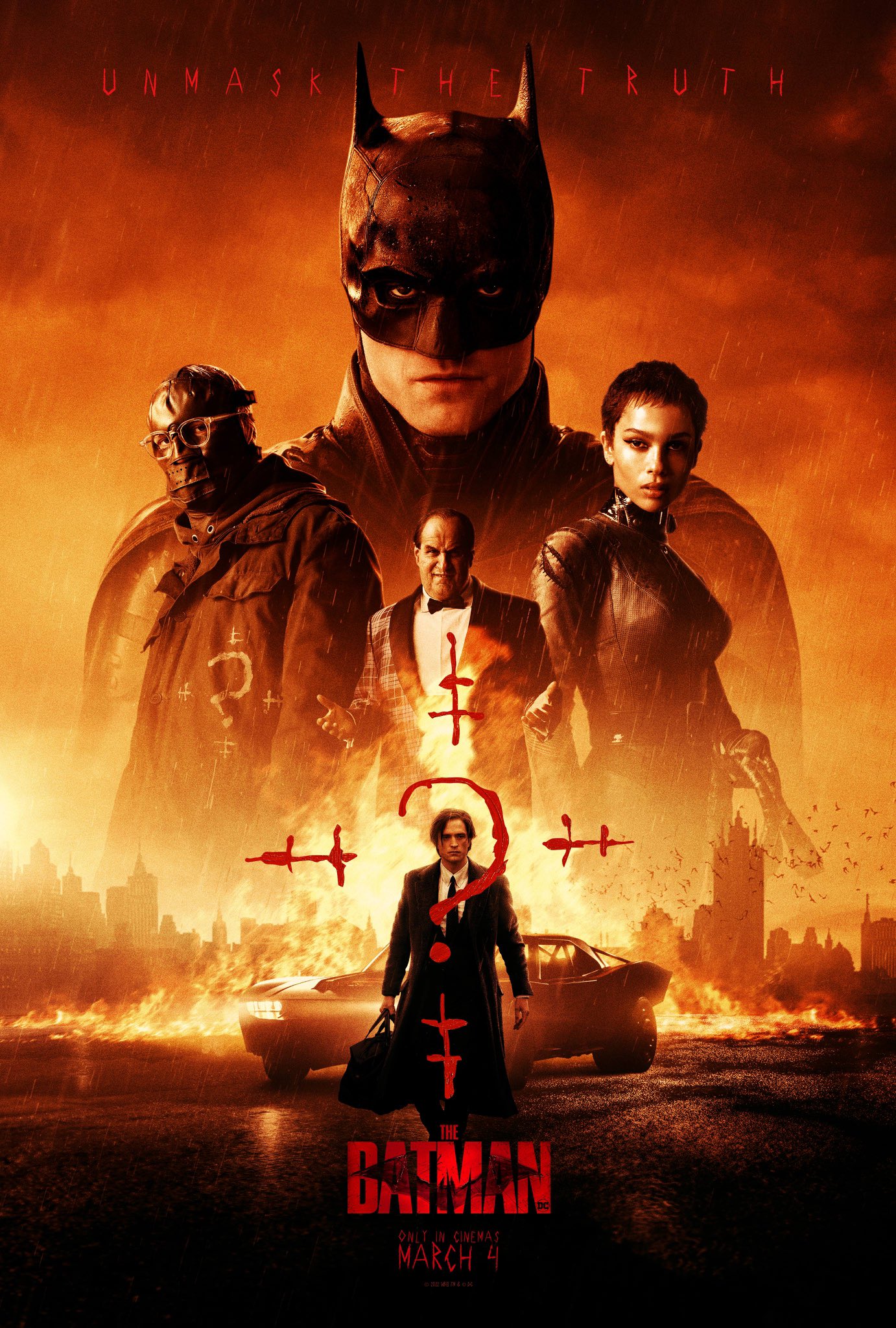
The Bible says, “Justice brings joy to the godly, but it terrifies evildoers” (Proverbs 21:15). This verse certainly rings true when it comes to the Batman’s particular brand of justice. In Matt Reeve's The Batman, the Dark Knight Detective haunts the streets like a vengeful shadow, striking terror in the hearts of evildoers.

In a scene at the start of the film, audiences receive a glimpse of several criminals scattered around the city as Batman monologues, “It’s a big city. I can’t be everywhere. But they don’t know where I am. We have a signal now. For when I’m needed. But when that light hits the sky, it’s not just a call. It’s a warning. To them. Fear is a tool. They think I’m hiding in the shadows. But I am the shadows.” The scene then focuses in on a band of hoodlums surrounding an innocent civilian. Before they can assault their target, they suddenly hear heavy footsteps coming from the shadows. As Batman emerges from the darkened corner, one of the assailants calls out, “Who the #@&%! are you supposed to be?” Before Batman says a word, the clown-faced thug swings a machete at the Dark Knight. In a swift series of savage strikes, Batman beats the hoodlum into the ground, then answers, “I’m vengeance.” After quickly dispatching the rest of the ruffians, Batman peers down at the cowering victim, then simply walks away.

Shadows. Vengeance. These things compose the gritty core of Batman at the onset of the movie. But as the story unfolds, the Caped Crusader experiences an interesting character arch. Throughout the film Batman wrestles with probing questions: Is he making Gotham better? Does vengeance do any good? What sort of hero does Gotham truly need?

Eventually Batman comes to the realization that he must become more than a shadowy slinger of batarangs and harbinger of vengeance. He must become a symbol of hope—a beacon of light, leading the way. This transformation is symbolized visually by Batman lighting a flare and rescuing a group of frightened citizens as the city suffers severe flooding. Reaching out his hand, he lifts them one-by-one out of the rising waters and uses his light to lead them to safety. He then continues to work in broad daylight alongside firefighters and emergency personal as he monologues, “I’m starting to see now… Vengeance won’t change the past, mine or anyone else’s. I have to become more. People need hope.”

Similarly, the Bible warns Christians not to pursue the path of vengeance. “Vengeance is mine, I will repay, says the Lord” (Romans 12:19 ESV). Rather, we are called and commanded to shine the light of Christ. Jesus declared to his disciples, “You are the light of the world. A town built on a hill cannot be hidden. Neither do people light a lamp and put it under a bowl. Instead they put it on its stand, and it gives light to everyone in the house. In the same way, let your light shine before others, that they may see your good deeds and glorify your Father in heaven” (Matthew 5:14-16 NIV).

Batman saved lives by lighting a flare and leading the way. Likewise, Christians must save souls by shining our lights and leading people to Jesus. Much like the citizens of Gotham, we are surrounded by darkness. But it’s in the darkness that our little lights shine the brightest. What does this look like? How do we become a light in the darkness? We offer help to the helpless. We offer hope to the hopeless. We love our neighbors and even our enemies. We do good deeds in broad daylight that give glory to God. Our goal is to point people to the world’s great hero—Jesus Christ. So, follow the Batman’s example. Leave vengeance to the Lord and let your light shine brightly!

Monday, November 28, 2022

Multiversal Madness!

From Scott's new book, Faith on Film:

The key plot devise of both Spider-man: No Way Home and Doctor Strange: Multiverse of Madness is the existence of alternate realities. In No Way Home, When Doctor Strange’s spell goes sideways, villains from across the multiverse (and previous Spider-Man films) begin appearing all over New York. Doctor Octopus and Green Goblin attack an unsuspecting Spidey on the Alexander Hamilton Bridge. Doctor Strange tracks the Lizard through the city sewers. Spider-Man captures Electro, with the help of Sandman, after a fight in a forest outside New York. Back in Doctor Strange’s Sanctum Sanctorum, Strange explains, “That little spell that you botched where you wanted everyone to forget that Peter Parker is Spider-Man, it started pulling in everyone who knows Peter Parker is Spider-Man from every universe into this one.”

“Every universe?” Peter repeats.

“Frankly,” Strange continues, “the Multiverse is a concept about which we know frighteningly little.” 
Wide-eyed, Peter replies, “The multiverse is real?”

Indeed, the multiverse is the driving plot devise of multiple movies in Phase Four of the Marvel Cinematic Universe, not to mention the 2018 animated adventure, Spider-Man: Into the Spider-Verse, in which multiple versions of Spider-Man from alternate realities team up to do battle with the nefarious Kingpin. The multiverse, or “Spider-Verse,” promises infinite possibilities, infinite Spider-Men and Spider-Women, infinite New Yorks, infinite Earths, infinite bad guys, and infinite storylines to be explored. But is the concept of alternate realities consistent with a biblical worldview? Is there any truth to the notion?

Scientifically speaking, Doctor Strange is right; the multiverse is a concept about which we know very little. This is because there’s no evidence that a multiverse actually exists. Other universes, if they do exist, are completely undetectable to us—and will probably remain so, regardless of technological breakthroughs and scientific discoveries. Alternate realities are relegated to the realm of science-fiction, not science-fact.

Often, the driving motivation behind multiversal theories is an attempt to explain away the “fine-tuning” of our universe, which is one of the most compelling evidences for the existence of God. Without getting too technical, astronomers and physicists have been stunned by the inescapable fact that our universe has laws and physical properties that are supremely suited to our human existence. These precisely balanced constants and quantities are known as the “fine-tuning” of the universe. In his book, The Grand Design, Stephen Hawking writes, “The discovery relatively recently of the extreme fine-tuning of so many of the laws of nature could lead at least some of us back to the old idea that this grand design is the work of some grand designer.” Likewise, the ardent atheist Fredrick Hoyle, the mathematician who actually coined the term Big-Bang, admitted, “a common-sense interpretation of the facts suggests that a super-intellect has monkeyed with physics.” 

In order to avoid the obvious implication of divine design, some scientists have posited the notion that a multiplicity of universes exists out there somewhere, each of them with totally random physical constants and laws of nature. However, from a scientific perspective, we really have no idea whether other universes exist, and we’ll likely never know, since those parallel universes will remain forever beyond our reach. 

In any case, Christians needn’t fear the notion of alternate realities. As Hawking’s fellow Oxford professor John Lennox points out, “God could create as many universes as he pleases. The multiverse concept of itself does not and cannot rule God out.” 

In the book of Revelation, the heavenly hosts proclaim, “You are worthy, O Lord our God, to receive glory and honor and power. For you created all things, and they exist because you created what you pleased” (Revelation 4:11 NLT). If multiple universes do exist, then God created them for his pleasure and glory just as he created ours. Perhaps one universe is simply not enough to fully glorify God. A suitable display of God’s glory just might require a multiverse. And, who knows? Maybe one of those universes is home to a real-life Spider-Man!

Friday, July 16, 2021

You Gave Me A Family

By Guest Writer C.L.Shoemaker 


He predestined us for adoption as sons through Jesus Christ, according to the purpose of his will (Ephesians 1:5)

See what kind of love the Father has given to us, that we should be called children of God” (1John 3:1)


When was the last time someone believed in you? If it’s been a while you may need to find yourself a Director Coulson and ask to be adopted. In Marvel’s Agents of SHIELD, Phil Coulson is tasked with forming an elite team for his bus (a flying, response unit). Instead of commandeering the Avengers or SHIELD’s top agents, Phil reaches out to individuals who have been overlooked. He hires Agent May, a closed off agent with PTSD, gives two fresh faced scientists a lab on his plane and invites a known hacker into the group. Where other agents see problems and liabilities, Coulson sees potential and value. For Phil, his carefully crafted SHIELD team is not just another group it’s his opportunity to cultivate a family.

His first questionable choice is to recruit Skye (later called Daisy), a hacker with no last name and no family. Having bounced from foster home to foster home, Skye desperately wants to belong and to be valued. When Phil catches her hacking into SHIELD’s mainframe from a beat-up van in a sketchy alleyway, he offers her a job.

During Skye’s intake interview, Ward, a high-level specialist, struggles to see her purpose declaring her an annoyance and a liability, while Phil giddily sees her as an asset.


Phil Coulson : She's an asset.

Grant Ward : She is such an ass-- wait, "asset"?


Ward doesn’t understand the innate value of a life and a person’s vast potential if they are supported. Ward prizes utilitarian skills; what can you do and how well. For him, individual worth is directly correlated to one’s physical or intellectual output. In contrast, Phil sees value in everyone regardless of their skillset, or lack thereof.


Grant Ward :  You're gonna risk thousands of lives over some nobody.

Phil Coulson : [Cheerily]  Nobody's nobody Ward.


While Ward see Skye’s faults, Coulson recognizes her potential. Phil’s superpower is his ability to see worth in everyone. As Skye later tells him, “You value me. You’re the first person to do that in a long time.” Phil’s talent is to see value in the valueless.

Phil consistently comes to the rescue of those alone, abandoned and without hope. The agent, and former Director, is known for his compassion and for giving second chances. As Agent May observes, “Coulson has more heart than most”. He values people and wants to bring them into community via SHIELD. In fact, Coulson takes a page form Jesus Christ, following in the messiah’s footsteps. Christ excelled at seeking out those who were lost, abandoned or overlooked. He offered second chances and invited them into a family. Through Christ’s death all of humanity can be welcomed back into the family of God. We are accepted and adopted as brothers and sisters in Christ. It is a diverse and unique family filled with misfits, failures and lost souls who have all been rescued, redeemed and restored through the precious blood of Christ.

With Coulson, Skye finds her forever family. She is adopted into SHIELD and welcomed regardless of her past. When Skye is seriously injured in season one and the doctors advise Coulson to contact her family, he responds with, “we are her family.” When, in season four, she runs away and goes rogue, the team searches for her with Coulson never giving up hope. Despite challenges, loss, and life-threatening experiences, the team is always there for Skye. In season seven when she finally meets her birth sister, her response is immediate: “I already have a sister. Her name is Jemma Simmons”. Skye’s answer confirms her love for her SHIELD family. The team she fought with, grew with, loved and lost with; they are her family. Skye refers to Phil as a father figure and a Christ-like figure, reminding him “You found me alone in an alley, and you gave me everything. A home, a belief, solid ground to stand on. That was all you! You are what I believe in.” (season 5 ep 12 “The Real Deal).

While you may not be invited to join Coulson’s team and become an agent of SHIELD, you are welcome to become a child of God. Christ offers a free invitation to join his family, to know your worth and value, and be part of the greatest mission on earth: the salvation of the world. The best part is you don’t need level 7 access, because membership in God’s family is open to everyone.


Friday, July 9, 2021

'Til the End of the Line!

In the first Captain America film, Bucky Barnes accompanies Steve Rogers home after his mother’s funeral, and even though Steve swears he can get by on his own, Bucky tells him, “The thing is, you don’t have to. I’m with you ‘til the end of the line, pal.”  These kind words reminded Steve that no matter what happens Bucky would be there for him. Fast forward seventy years. When Captain America learns that HYDRA brainwashed and genetically modified Bucky into a killing machine known as the Winter Soldier, Steve tries to get through to Bucky by reminding him of their friendship. “I’m not going to fight you,” Cap says while throwing down his shield. “You’re my friend… I’m with you to the end of the line.”  This one heartfelt line sums up the unwavering loyalty between Cap and Bucky.

If anyone understands that level of loyalty, it’s Ruth.

In the first chapter of Ruth’s self-titled book of the Bible, we learn that a severe famine swept across the land. So, a man named Elimelech, his wife Naomi, and their two sons left their home town of Bethlehem and settled in the country of Moab. The two boys eventually grew up and married two Moabite women—Orpah and Ruth. Within a short span of time, however, all the men in the family died. With no husband or sons, Naomi was in danger of going hungry or homeless. So, she decides to move back home to Bethlehem where her countrymen could take care of her. At first, both Ruth and Orpah offer to accompany Naomi on her journey. But on the way, Naomi has second thoughts. She turns to the girls and tells them, “Go back to your mothers’ homes. And may the Lord reward you for your kindness to your husbands and to me. May the Lord bless you with the security of another marriage” (Ruth 1:8-9 NLT). Then she kisses each of them goodbye, and they all start sobbing.

The girls protest, but Naomi argues that they’d have no future with her. They’d just be three old spinsters living in a shack together. They’d never make ends meet. She tells them that they’d be better off returning home, meeting another man, getting married again and moving on with their lives. Then, the Bible says they all starting crying again!

Finally, Orpah kissed her mother-in-law goodbye and headed home. But not Ruth. The Bible says Ruth “clung tightly to Naomi.” This brave young woman saw Naomi’s heartache and the hardship ahead of her, and made one of the most beautiful pledges in the Bible: “Don’t ask me to leave you and turn back. Wherever you go, I will go; wherever you live, I will live. Your people will be my people, and your God will be my God. Wherever you die, I will die, and there I will be buried. May the Lord punish me severely if I allow anything but death to separate us!” (Ruth 1:16-17 NLT).

These are among the most touching, heartfelt words ever recorded. Ruth and Naomi came from different cultures, backgrounds, and generations. As mother-in-law and daughter-in-law, they probably had as many opportunities for tension as they did for tenderness. But no matter what, Ruth refused to turn her back on Naomi. Ruth promised to be with Naomi ‘til the end of the line.

Ruth not only pledged her loyalty to Naomi, but also to Naomi’s God. In fact, their mutual faith in the Lord bound them together more than anything else. Ruth’s unwavering loyalty speaks volumes about her character.

Loyalty is an often overlooked and underrated virtue. A loyal person keeps their vows, honors their commitments, and is consistent and reliable in season and out of season—that is, when it’s convenient and when it’s not. A loyal person will be there for you ‘til the end of the line. That’s the kind of person Ruth was. Ruth pledged her loyalty both to Naomi and to the Lord, and she followed through on that pledge. We could all stand to be a little more like Cap, Bucky, and Ruth.

Friday, March 19, 2021

Sibling Rivalry


You'd be hard pressed to find any two Marvel comicbook characters more divergent than the X-Men's Charles Xavier and the unstoppable Juggernaut, Cain Marco. Though physically disabled and wheelchair-bound, Charles Xavier—known to his students as Professor X—uses powerful psychic abilities to fight for peace and equality between humans and mutants. Cain Marco, on the other hand, unearthed a legendary stone called the Crimson Gem of Cyttorak and, upon touching it, was transformed by its mystical energies into a hulking human juggernaut. Where Charles relies on his brains, Cain depends on his brawn. Who would have guessed these extreme opposites are actually brothers?

Cain's mother died at an early age, condemning Cain to suffering at the hands of his abusive father, Kurt. Eventually, Kurt married Charles's mother, Sharon.  But when Kurt seemingly preferred Charles to his own son, Cain became consumed with jealousy and took to bullying his stepbrother. Despite growing up in the same house, Charles and Cain's paths diverged more and more.  Eventually, Charles became a hero and Cain became a villain. Cain has repeatedly attempted to kill his stepbrother Charles as the superpowered Juggernaut. Thankfully, Professor X always manages to overcome his stepbrother's rage-fueled rampages. 

The Bible tells a remarkably similar story about Abel and his brother, whose name also happens to be Cain. Stan Lee undoubtedly drew inspiration from this biblical tale when crafting the characters of Xavier and Juggernaut.

Soon after Adam and Eve's eviction from the Garden of Eden, the Bible tells us that Eve became pregnant and gave birth to a boy she named Cain. Later, she had another son whom she named Abel. Considering God’s command to "be fruitful and multiply," Adam and Eve likely had many other children, but these two steal the spotlight as one becomes a hero and the other a villain.

"When they grew up," the Bible says, "Abel became a shepherd, while Cain cultivated the ground. When it was time for the harvest, Cain presented some of his crops as a gift to the Lord. Abel also brought a gift—the best portions of the firstborn lambs from his flock. The Lord accepted Abel and his gift, but he did not accept Cain and his gift" (Genesis 4:2-4 NLT).

You probably already know what happened next. Anyone who hears the story can never forget. In a fit of jealousy and rage, Cain attacked and killed his brother Abel, becoming the first "bad guy" of the Bible. So what made Cain a villain? In a word, jealousy.

Just as Cain Marco envied young Charles Xavier for being his father's favorite, Cain envied the fact that Abel was accepted by God while he wasn’t. His jealousy turned to rage and his rage led to murder. By allowing his jealousy toward his brother to fester and grow, Cain cast himself as the villain in Abel's story.

Envy or jealousy can be found on nearly every list of sins in Scripture. The Bible frequently warns believers about the dangers of jealousy. For instance, Proverbs cautions, "Anger is cruel, and wrath is like a flood, but jealousy is even more dangerous" (Proverbs 27:4 NLT) and " jealousy is like cancer in the bones" (Proverbs 14:30).

As punishment for Cain's horrendous crime, God cursed the ground of Cain so that it would not provide him with food and condemned Cain to walk as a fugitive on the earth. However, God showed mercy by placing a mark on Cain so that no one could kill him in vengeance (Genesis 4:11–16). We too can experience God's mercy to a much greater degree. The Bible says, "Our lives were full of evil and envy, and we hated each other. But—when God our Savior revealed his kindness and love, he saved us, not because of the righteous things we had done, but because of his mercy. He washed away our sins, giving us a new birth and new life through the Holy Spirit" (Titus 3:3-4).

If you struggle with feelings of envy or jealousy, don't let those feelings fester. Instead, turn them over to God. Confess your feelings and allow the Lord to wash away the anger and envy in your heart, replacing with new life through His Spirit!

Friday, August 28, 2020

A True Friend - Deke Shaw

By Guest Writer C.L.Shoemaker

Blessed be the God and Father of our Lord Jesus Christ, the Father of compassion and the God of all comfort, who comforts us in all our troubles, so that we can comfort those in any trouble with the comfort we ourselves have received from God. - 2 Corinthians 1:3-4


In the final time travelling season of Marvel’s Agents of SHIELD (season 7 episode 7 “The Totally Excellent Adventures of Mac and the D”) director Alphonso Mackenzie (Mac), the moral compass of the team, is crushed when he discovers his parents have been murdered. Killed by chronicoms, a robotic threat SHIELD has been fighting, Mac’s parents were replaced by sentient duplicates that he is then forced to destroy. Overwhelmed at having lost his parents, and having to kill their false copies, Mac leaves the team to go for a ride and clear his head. Upon returning the team’s ship malfunctions, jumping forward in time, leaving Mac and Agent Deke Shaw stranded in 1982.

After panicking about being stuck in the 80s, Deke, a new member of the crew, sets his concerns aside to help Mac. Despite having made mistakes in the past and failing to be an ideal agent, Deke values loyalty and is concerned for his friend. When Mac berates Deke for past irresponsible actions, Deke still tries to help. 

Deke: I’m sorry you lost your parents. If there was anything else we could have done differently –
Mac: You could have followed orders. Who are you to take a life in your own hands even if you think it’s right.
Deke: I lost my parents early too, ok. And I still think about it every day. If you want to talk, I’m here.
Mac: I’m good. 
Deke: Wait, wait, wait … We need a game plan. What if the chronicoms are still out there? Maybe that’s why we’re still here?
Mac: You figure it out. (Riding off)
Deke: (Yelling) Mac! Mac! You don’t have to go through this alone.


Just like Paul in second Corinthians, Deke knows the pain of suffering and loss. He understands that pain can be a training ground for helping others face a similar heartbreak. Deke grew up in a post-apocalyptic future where humans were under alien slavery. He survived by being smart, sly and determined. As he tells Mac, he also lost his parents at an early age. Deke is desperate for family and belonging, and as a result of that need, he understands loss and loneliness. He wants to help Mac because he has been there, and he understands what Mac is going through. 
Deke is also an ideal friend who never gives up. While Mac shuts himself away from the world and turns to drink (something he later comments he wasn’t proud of) Deke tirelessly tries to reach out. Upon learning Mac’s location, Deke arrives ready to go to the park and “kick the ball around”. Despite literally having a door slammed in his face, Deke keeps trying. He is unwavering in his love for his friend, dropping off groceries on New Year’s Eve and inviting Mac to a show at Swayze’s bar later in the year. 

When Mac shows up at the bar, Deke’s excitement is palpable. He introduces Mac to the new team, The D Squad, and makes him the director, despite Mac rejecting the role. Back at headquarters, Mac has nothing to offer but criticism. However, Deke is too thrilled to have Mac back to register the bad attitude. He even gives Mac his own personal weapon, the shotgun axe, noting: “You think I’m going to let my director go out into the field with anything less.” But Mac doesn’t want to be a part of a team. His anger and frustration come out in an attack against Deke, calling him and the D Squad useless. 

In the resulting argument Deke self-sacrificially stands up for his incompetent team knowing they simply need training. We also see that Deke won’t give up on Mac, even if his friend is lashing out in anger.

Deke: The team needs you to get it together.
Mac: That’s not a team. It’s a bunch of losers playing dress up lead by a Peter Pan in constant need of attention
Deke: Look, you can say whatever you want about me, I can handle it, but don’t you ever talk about my team that way … They have my back and they won’t give up on me when the going gets tough. Just like I didn’t give up on you.
Mac: I didn’t ask for that.
Deke: You didn’t have to because that’s what friends do for each other.


When Roxy chews Mac out for his bad attitude he learns that Deke has been visiting 1980s 10-year-old Mac and his brother Ruben, gifting school supplies, toys and a drum kit. While Mac couldn’t help his younger self, as he himself was grieving, Deke could. Having perspective and experience with loss, Deke went in Mac’s stead and encouraged the young brothers. Mac is both shocked and touched by Deke’s selfless nature and it is this kindness that turns Mac’s heart around.
Mac’s change comes at the ideal time as he saves the D Squad from a killer robot and takes over leading the rookie group. Deke, ever forgiving, welcomes Mac back with open arms as their director learns a lesson in forgiveness and humility.

Deke: You came back.
Mac: Never should have left (holds out his hand to Deke and they shake).
Chang: Any ideas on what to do next?
Mac: A few. If your team will have me.

When the original SHIELD team finally jumps back to 1983, Yo-yo, Mac’s girlfriend, reflects that “no one should ever have to go through [loss] alone.” Thankfully Mac wasn’t alone as he informs her, “It wasn’t easy, but … I had friends.” He had the unwavering friendship of Deke Shaw, “a friend who sticks closer than a brother” (Prov 18: 24). 


Mac was blessed by Deke, a faithful friend who cared about Mac’s brokenness. Community and friendship were vital to Mac’s recovery. It was unhealthy for him to try to go it alone as Coulson observed, “isolating yourself just isn’t healthy. You need your friends, especially during the rough patches.”

The Bible speaks about the importance of community and friendship when dealing with loss, pain, or hurt. God created the church as a community of believers to offer help and encouragement. Likewise, God praises friendship, highlighting the importance of close relationships for support and care: “A friend loves at all times and a brother is born for a time of adversity” (Prov 17:17). We can even use our painful experiences to help others who are struggling (2 Cor 1:3-4). What hurt have you gone through that you can use to help others? Are there any friends in your life, like Mac, that could use a support network? How can you be a Deke Shaw to someone you love? 


Thursday, July 9, 2020

"I have faith" - Peggy Carter

By Guest Writer: C.L. Shoemaker

“Now faith is confidence in what we hope for and assurance about what we do not see.” - Hebrews 11:1
*
In Marvel’s film Captain America Steve Rogers, an army hopeful during WWII, is consistently rejected when enlisting due to his medical issues. Desperate to serve his country, he jumps at a chance to test a new super soldier serum. Yet, when the lead scientist on Project Rebirth is assassinated, and the only serum destroyed, Steve remains the project’s sole success. Relegated to selling war bonds and promoting the American troops, Rogers is dejected at his inability to make a difference. He has superhuman strength, intelligence and agility yet, he’s reduced to a performing puppet for the army instead of fighting on the front lines.


It isn’t until Steve befriends Agent Peggy Carter that he is challenged to think beyond the identity imposed on him. After watching Steve’s USO show for the surviving members of the 107th Peggy sees through his façade and questions his role as “America’s new hope” asking, are “these are your only two options? A lab rat or a dancing monkey? You were meant for more than this you know.” Peggy has faith that Steve can be better because at heart he is a good man. She isn’t counting on his super soldier abilities (speed, agility, strength). She knows what makes Steve special is his character and his heart. He may have changed physically but internally, he’s still the same, good man, and he needs to see his value. Peggy sees his potential and his ability to have a higher purpose. She understands his desire to use his gifts to do good and help. While others have mocked Steve as a glorified chorus girl, Peggy knows that he was chosen for a greater purpose. He only needs to see it and step out in faith.

It isn’t until Steve learns that his best friend, Sgt. Bucky Barnes and his squadron were captured that Steve decides to take action. He will no longer hide behind his shield, but he will use it as a weapon to protect others. Despite assumptions that Barnes is dead, Steve has faith that his friend is alive. Steve believes he can make a difference even as Peggy, his previous cheerleader, protests, 

Peggy: “You heard the Colonel. Your friend is most likely dead.” 
Steve: “You don’t know that.”
Peggy: “Even so, [the Colonel’s] devising a strategy.”
Steve: “By the time he does that it could be too late.”
Spurred on by the knowledge of men captured behind enemy lines, Steve grabs his shield, a leather jacket and prepares to steal an army jeep. Before leaving he turns to Peggy, who has followed him with protests, and asks if she still believes in him: 
Steve: “You told me you thought I was meant for more than this. 
Did you mean that?”
Peggy: [without a pause] “Every word.”
Steve: “Then you gotta let me go.”

On the encouragement of one woman and a threat to his friend’s life, Steve changes from a man trapped by circumstance and without purpose to a man driven by faith towards a life changing goal. There is no proof that Bucky is still alive and no scientific data that claims Steve will be able to rescue anyone, but he believes he can achieve, and he is willing to act on that faith. He also listens to Peggy’s advice, that he was created for more and embraces the knowledge that perhaps he was made “for such a time as this” (Esther 4:14). If anyone has the abilities, strength and knowledge to save the 107th it’s Steve Rogers, a superpowered super soldier with an “I can do this all day” attitude. Steve is self-sacrificial and willing to put others first even risking his own life. It is this goodness and sacrifice that earned Steve the coveted spot in Project Rebirth (the super soldier program).

Working with Agent Carter and Howard Stark to pilot a plane, Steve is dead dropped into the middle of enemy territory and then there is silence … for days. When we next see Peggy Carter she is bringing the Colonel images from the last surveillance flight. There is nothing to report. Steve has disappeared. While she is berated for her actions and blamed for the death of Captain America and the lost 107th, Peggy’s response is simple. Faith. She had and still has faith in Steve Rogers. She believes he is meant to do great things and that he will come back. When everyone else has given up hope, Peggy’s faith still endures.


Peggy: “With respect sir, I don’t regret my actions and I don’t think Captain Rogers did either”
Col. Phillips: “I took a chance with you Agent Carter and now America’s golden boy and a lot of other good men are dead because you had a crush.”
Peggy: “It wasn’t that. I had faith” 
Col. Phillips: “Well I hope that’s a big comfort to you when they shut this division down.”

At that moment a commotion occurs as soldiers run from their tents to see Captain America and the rescued 107th march into the camp. Some are injured, others healthy enough to walk while some ride on an army tank. Col. Phillips looks over at Peggy and says two words, “Faith, huh?”

It only took one person to see the potential in Steve Rogers after Project Rebirth was shut down and he was delegated to war bond duty. Agent Carter knew Steve’s true value was in his strong character and heart, and she helped him to see his role, as the man he longed to be and the hero he wanted to become. The serum enhanced Steve’s abilities, but it was a woman of faith who helped Steve Rogers take his first step as Captain America. 

Believers could learn a lot from Agent Carter's faith. Scripture says, "The righteous will live by faith" (Romans 1:17). Just as Peggy had faith in Steve's ability to become a hero and rescue his fellow soldiers, let us have faith in our heavenly Hero, Jesus Christ, who rescues the captives, heals the broken hearted and saves the day!

Friday, June 5, 2020

I Was Made For This!

During a pivotal scene in Avengers: Endgame, Hulk delivers one of the most profound and powerful lines of the movie. After successfully gathering all of the Infinity Stones and returning to their own time, a brief argument breaks out over who will wear the Infinity Gauntlet and undo the death and destruction wrought by Thanos. Thor insists on being the one, saying, “I’m the strongest Avenger, okay. So, this responsibility falls upon me.” When Tony objects, Thor persists, “What do you think is coursing through my veins right now? Lightning!” That’s when Hulk steps in, saying, “Lightning won’t help you, pal. It’s got to be me. You saw what those stones did to Thanos. They almost killed him. None of you could survive… The radiation is mostly gamma. It’s like… I was made for this.” In that moment, Hulk recognized a preordained, perhaps even divine, purpose to his life. He didn’t always recognize his purpose, though.

Way back in the first Avengers movie, Tony and Bruce have a conversation about Bruce’s hatred of the Hulk. Tony says, “Hey, I’ve read all about your accident. That much gamma exposure should have killed you.” Bruce replies, “So you're saying that the Hulk... the other guy... saved my life? That's nice. It's a nice sentiment. Saved it for what?” Tony smirks and says, “I guess we'll find out.” Seven years and several movies later, Bruce finally found out what he was saved to do. He discovered his purpose.

Have you discovered yours? Like Bruce Banner, you and I were created for a purpose and saved for a purpose. Pastor and author, Rick Warren, writes, “The purpose of your life is far greater than your own personal fulfillment, your peace of mind, or even your happiness. It’s far greater than your family, your career, or even your dreams and ambitions. If you want to know why you were placed on this planet, you must begin with God. You were born by his purpose and for his purpose.”

Scripture continually confirms this claim. God told the displaced people of Israel, “For I know the plans I have for you…plans to prosper you and not to harm you, plans to give you hope and a future” (Jeremiah 29:11 NIV). Likewise, the New Testament assures Christian, “And we know that God causes everything to work together for the good of those who love God and are called according to his purpose for them” (Romans 8:28 NLT). And, similarly, “For we are God’s masterpiece. He has created us anew in Christ Jesus, so we can do the good things he planned for us long ago” (Ephesians 2:10 NLT).

 God has a purpose and plan for each one of us. Like Bruce Banner, you may not be aware of your purpose at first. But, if you will seek God and search the Scriptures, then you’ll discover God’s purpose and plan for your life and you’ll be able to join Hulk in saying, “I was made for this.”


This post is an excerpt from my latest book, Endgame: Finding God Among Earth's Mightest Heroes, available on Amazon! 

Monday, May 25, 2020

A Mighty Hero!

Excerpted from my upcoming book, Holy Heroes of the Bible:

Marvel's Avengers are knowns as "Earth's Mightiest Heroes" and, among them, Thor holds the title of "the mightiest Avenger." Yet, even the mightiest of Earth's mightiest heroes recognizes a Hero far mightier than himself. In The Mighty Thor Annual #14, the son of Odin confesses, "Even I, son of one of the mightiest gods, find it impossible to conceive of such levels of power! And 'tis a humbling thought to consider how much greater the Creator of all universes must be than that of all His creations combined!"[1]

As Thor points out, nothing reveals God's inconceivable might more clearly than the creation of the universe. Genesis 1 sums up the creation of the cosmos in the very first sentence: "God created the heavens and the earth." The phrase "the heavens and the earth" encompasses all of creation—the entire universe: quarks, neutrons, hydrogen, stars, planets, galaxies, gravity, even time and space. The sheer vastness of the universe boggles the mind. Just think about the stars for a moment. Those gleaming lights twinkling against a black velvet sky are overwhelming not just in splendor, but in number. Have you ever tried counting the stars? Three hundred years ago astronomers believed there were just over a thousand stars in the universe, today we know that there are as many as 300,000,000,000 stars in our galaxy alone, which is just one of billions more galaxies stretched across the cosmos. Reflecting on the cosmic creation event, the psalmist wrote, "The Lord merely spoke, and the heavens were created. He breathed the word, and all the stars were born" (Psalm 33:6 NLT). As Thor admitted, it seems "impossible to conceive of such levels of power." Yet, verse one is just the beginning. The rest of the chapter zeroes in on the creation of the earth and everything in it—the oceans, rivers, land, mountains, trees, plants, animals, and even human beings. God is big enough to breathe out stars, yet delicate enough to fashion together the trillions of cells that make up every facet of who you are. And with each act of creation, the Bible tells us, "God saw that it was good" (Genesis 1:10,12,18,21,25).

Let's conduct an experiment. Close your eyes. Take a deep breath. Now, create and ocean. Can't do it? Try something smaller, like a gazelle or giraffe. Still nothing? How about something super simple like an ameba or an atom? Didn't work, did it? That's because human beings don't possess the power to create something out of nothing. Only God does!

Speaking of all the wonders God wrought on earth and throughout the heavens, Job says, “These are just the beginning of all that he does, merely a whisper of his power. Who, then, can comprehend the thunder of his power?” (Job 26:14 NLT). Even today with our ever-expanding knowledge of the universe and the atom, we’re still just seeing a whisper of his power, "the outer fringe of his works" (NIV).

Scripture frequently speaks of God's "mighty power" (Exodus 14:31) and "the power of his mighty hand" (Exodus 13:14). The Bible says, "He is the great God, the mighty and awesome God" (Deuteronomy 10:17) and "The Lord, the Mighty One, is God!" (Joshua 22:22). As evidenced by his incredible creation, God is a mighty hero. In fact, God isn't just a mighty hero, he's the Almighty Hero!


[1] Marvel Comics. The Mighty Thor Annual (Vol 1) #14 (1989)

Friday, July 5, 2019

A Tangled Web!


I took my son and daughter to see Spider-man: Far from Home yesterday, and the movie far exceeded our expectations. This angsty, action-packed sequel picks up where Avengers: Endgame left off and follows Peter Parker on a humorous and heartfelt European vacation. But it’s the villain of the story who really steals the spotlight.

Spoiler Warning

When four elemental monsters begin wreaking havoc all across Europe, a mysterious new hero emerges claiming, “I’m here to save your world.” This courageous new hero, dubbed Mysterio by Peter and his classmates, fends off the elemental monsters at great personal risk while simultaneously forming a friendship with Peter. Believing Mysterio to be much more capable and competent than himself, Peter gives Mysterio control of EDITH—a billion-dollar tactical system embedded in a pair of sunglasses that he inherited from Tony Stark. Not surprisingly, Mysterio isn’t what he seems.

To his horror, Peter discovers that Mysterio, Quentin Beck, isn’t a hero at all. Rather, Beck turns out to be a brilliant but unbalanced ex-employee of Stark Industries. Beck utilizes advanced technology to create incredible illusions. The elemental monsters are nothing more than holographic projections and special effects. Beck desperately wants the world to believe that he is an Avenger’s level hero and he’s willing to orchestrate cataclysmic disasters to accomplish his goals. With EDITH now under Beck’s control, he plans another duplicitous demonstration of daring-do that will level half of London, and it’s up to Spider-man to stop him.

Mysterio reminds me a great deal of a man we read about in the Bible named Jacob. Much like Mysterio does with Peter, Jacob once tricked his older brother, Esau, into handing over his inheritance. Later, Jacob disguised himself as Esau in order to deceive their father, Isaac, into giving him the family blessing too. Jacob eventually repented and became a godly man, but the world remains replete with people who pretend to be something they aren’t in order to deceive others.

Jesus warned his followers, “Beware of false prophets who come disguised as harmless sheep but are really vicious wolves” (Matthew 7:15 NLT). The Apostle Paul also warned about false prophets, saying, “They are deceitful workers who disguise themselves as apostles of Christ. But I am not surprised! Even Satan disguises himself as an angel of light. So it is no wonder that his servants also disguise themselves as servants of righteousness.” (2 Corinthians 11:13-15 NLT). Satan and his servants can deceive people by appearing to be attractive, upright and virtuous. Many unsuspecting believers have followed smooth-talking, Bible-quoting leaders into destructive heresies or dangerous cults. This is why it’s important for Christians to be watchful and wary.

Peter Parker learned the hard way that appearances can be deceiving. Thankfully, Mysterio’s evil scheme failed and Spider-man won in the end. Christians can take heart that even though deceitful schemers may fool us on occasion, God will never be fooled and, like Spidey, God always wins in the end.  


Saturday, June 29, 2019

The New 42: God Terraforms All Things


I just finished reading The New 42: God Terraforms All Things, written by two of my fellow godly geeks, Eric Anderson and Nathan Marchand, and wanted to take a moment to recommend it to everyone reading this.

The New 42 is a fun-filled, faith-fueled adventure, exploring the depth and breadth of geekdom and the gospel. What impressed me most is the broad scope of fantasy and fandom contemplated throughout the book. Perusing these pages, you’ll find insights drawn from Star Trek, Star Wars, Stargate SG-1, Doctor Who, both Marvel and DC Comics, Minecraft, Firefly, Teenage Mutant Ninja Turtles, Heroscape, Godzilla, Disney, and a variety of anime. Similarly, The New 42 spans the full scope of Scripture. It starts “in the beginning” and weaves through the Bible before climaxing in the book of Revelation. While both authors offer valuable contributions, Nathan Marchand’s writing really sings. He has a knack for succinctly summarizing stories in such a way that make the reader feel familiar with them even if they’ve never heard of, for instance, Full Metal Alchemist or Bulletproof Monk. Ultimately, The New 42 will appeal to Christ-following nerds and geeks whatever their fandom.

Thursday, June 27, 2019

Avengers: Endgame - Not Us

Guest Writer: Nathan Marchand

With Avengers: Endgame re-releasing this weekend (my birthday, no less!), a couple friends and I decided to write a trilogy of devotional blog posts centered on the characters in the film. What follows is my contribution. Be sure to check out the other two here and hereAlso, it should go without saying, but SPOILER WARNING!

On the surface, it looks like Steve Rogers (aka Captain America) is coping with Thanos’ victory in Avengers: Infinity War pretty well, though perhaps in an unexpected way. He becomes a grief counselor. During the session, one man says, “So I, uh... Went on a date the other day. First time in five years, you know? Sit there, dinner.... I didn't know what to talk about.”

“What did you talk about?” Steve asks.

“Same old crap, you know? How things have changed, and...my job, his job.... How much we miss the Mets. Then things get quiet.... He cried as they were serving the salads.”

“How about you?”

“I cried...just before dessert. But I'm seeing him tomorrow, so....”

“That's great. You did the hardest part. You took the jump, you didn't know where you were gonna come down. And that's it. That's those little brave baby steps you gotta take. To try and become whole again. To try and find purpose. I went in the ice in forty-five right after I met the love of my life. Woke up seventy years later. You got to move on. Got to move on. The world is in our hands. It's left to us guys, and we have to do something with it. Otherwise...Thanos should have killed all of us.”
In the very next scene, though, he meets a frazzled, half-blonde Natasha Romanov (aka Black Widow) in her makeshift office as she coordinates heroes across the galaxy. After some chitchat, Steve admits that he can’t take his own advice. “I keep telling everybody they should move on. Some do, but not us.”

In the five years since “the Snap,” Steve hasn’t been able to accept their failure—his failure—to stop it. He hasn’t been able to accept the fractured universe the Mad Titan left in his wake. Even Thanos’ execution by Thor couldn’t satisfy Steve’s sense of justice. That universal genocide shouldn’t have happened. The misery he encountered every day because of it shouldn’t exist. The man who never backed down from a bully, whether he met him in an alley or the battlefield, regretted there was one he couldn’t stop.

Hence why when Scott Lang (aka Ant-Man) escapes the Microverse and tells him about his “twelve percent of a plan” to travel back in time to gather the Infinity Stones and use them to undo Thanos’ handiwork, Steve leaps at the chance. It’s a longshot, but it’s a shot. The colossal wrong could be made right.

Perhaps that’s why, in one of the most epic moments I’ve ever seen on film, Steve was worthy to wield Mjolnir when he faced Thanos again.


In 2 Kings 22, we meet Josiah, a boy who ascended to the throne of Judah at age eight. Unlike his evil grandfather Manasseh, “[h]e did what was right in the eyes of the Lord and followed completely the ways of his father David, not turning aside to the right or to the left” (v. 2). As an adult, he sent his secretary, Shaphan, to attend to business at the temple. While there, he learned the high priest, Hilkiah, had discovered the Book of the Law, which had gone missing for decades, if not longer. Shaphan returned to the king and read from the Book. Josiah’s reaction was visceral:

When the king heard the words of the Book of the Law, he tore his robes. He gave these orders to Hilkiah the priest, Ahikam son of Shaphan, Akbor son of Micaiah, Shaphan the secretary and Asaiah the king’s attendant: “Go and inquire of the Lord for me and for the people and for all Judah about what is written in this book that has been found. Great is the Lord’s anger that burns against us because those who have gone before us have not obeyed the words of this book; they have not acted in accordance with all that is written there concerning us” (2 Kings 22:11-13).

Josiah then sent Shaphan and the priests to inquire the prophetess Huldah concerning this. Thankfully, she said the Lord was pleased with Josiah’s humility, so Josiah wouldn’t see the disaster 

He would bring upon Judah.

In the following chapter, Josiah gathered his people and read from the Book of the Covenant. “The king stood by the pillar and renewed the covenant in the presence of the Lord—to follow the Lord and keep his commands, statutes and decrees with all his heart and all his soul, thus confirming the words of the covenant written in this book. Then all the people pledged themselves to the covenant” (2 King 23:3). This marked the beginning of a massive reform. All the pagan objects in the temple were removed. Idols and Asherah poles were removed from sacred places and smashed. Mediums and spiritists were cast out. Verse 25 tells us, “Neither before nor after Josiah was there a king like him who turned to the Lord as he did—with all his heart and with all his soul and with all his strength, in accordance with all the Law of Moses.”

There is much evil in the world. There has been since Adam and Eve ate that forbidden fruit. In their heart of hearts, every human who has ever lived carries the echoes of Eden. They know the world is not right, even if they don’t say they do. Christians, though, are fully aware of it, and our hearts burn with a righteous indignation. It’s the fire that burns when we hear about things like sex trafficking. It compels us to act, to fight against the evil. This “holy discontent” makes us refuse to accept this as “normal,” because it was never part of God’s design, and we know this. We can’t simply “move on” with our lives as if nothing happened. Just like “the Snap” drastically altered the Marvel Cinematic Universe, so the Fall of Man changed ours. Now we must take back what we lost by taking Gospel to the ends of the Earth, and through its power undo the evils of sin.

Captain America and King Josiah couldn’t stand by while evil pervaded the world, and neither can we.

It’s time we all lift Mjolnir, my friends.

Monday, June 24, 2019

The Holy Heroes Devotional Promo Video!


My new book, The Holy Heroes Devotional, is now available on Amazon! The Holy Heroes Devotional is a forty-day devotional that finds spiritual meaning in superhero movies and empowers believers to know Christ better through comic books!

You'll find devotions on some of the most iconic superheroes in theaters today, like Shazam, Captain Marvel, and Aquaman. But you'll also learn lessons from lesser-known comic book characters like the guardian angel Zauriel and the glory-hound Booster Gold. Each devotion concludes with a series of questions to ponder and a prayer. You'll discover surprisingly relevant and relatable life lessons and biblical truth buried in the stories of your favorite superheroes, and you'll be encouraged to embrace Jesus as the world's greatest hero!

Featured Post

Jesus Christ: World's Greatest Hero!

I'm excited to announce that the comic-book project I've been working on for the past year is finally finished! Jesus Christ: Th...